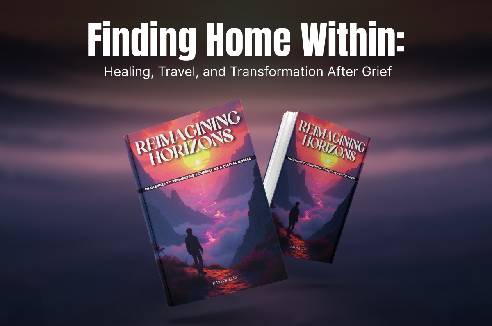
Grief has a way of reshaping everything it touches. It alters routines, challenges assumptions, and, perhaps most profoundly, redefines what we consider home. For those who have lost a lifelong partner and the familiar structures of life. The shared meals, morning rituals, and quiet conversations suddenly vanish, leaving a vacuum that feels impossible to fill. Home, once a place of safety and identity, becomes a collection of memories, objects, and echoes of a life that cannot be reclaimed. In such moments, the journey of healing is less about replacing what was lost and more about rediscovering oneself and reimagining what it means to truly belong.
Visit: https://harperlawbooks.com/
The weight of memory is inescapable after the death of a lifelong partner. Every corner of the house, every photograph, every object can trigger remembrance, both comforting and painful. For the author of the memoir, Celia, his wife of over fifty years, was the emotional center of the family, the anchor around which life revolved. Her gradual decline due to emphysema and eventual death did more than break a heart; it dismantled the very notion of home. Grief became severe and acute, leaving him isolated in a house filled with reminders of a life once shared. The challenge lies not in forgetting, but in learning to live with memory in a way that honors the past while making space for the future.
Amazon: Reimagining Horizons
Navigating this terrain often requires boundaries, self-reflection, and guidance. Emotional dependency can emerge when grief isolates and overwhelms, making it tempting to seek solace in others who provide stability or companionship. In the memoir, the author’s relationship with Anna, initially a caregiver for Celia, illustrates the complexities of emotional reliance. While Anna’s presence offered comfort and consistency, the blurred lines between care and personal expectation created tension. Therapy played a crucial role in unpacking these dynamics, helping the author recognize how grief can distort perception, foster dependency, and obscure the individuality of others. By confronting guilt, clarifying limits, and embracing self-discovery, the author learned to navigate grief without sacrificing autonomy or the authenticity of relationships.
Travel became both an escape and a catalyst for transformation. Journeys through places like Europe, Assisi, Venice, Paris, and Berlin offered moments of reflection, awe, and reconnection with a world beyond grief. Yet it was Georgia that became the true symbol of renewal. The country’s landscapes, traditions, and deliberate pace of life resonated deeply, offering a space where the author could imagine a life rebuilt rather than merely continued. Georgia’s hospitality and rhythms created an environment that mirrored the internal work of healing: patience, attentiveness, and openness to change. Travel, in this sense, was not just physical movement; it was a symbolic act of stepping into new possibilities, testing the boundaries of what life could look like after profound loss.
Through these journeys, the memoir demonstrates that healing is intertwined with curiosity. Rather than clinging to the past, the author embraced a nomadic phase, exploring not only new places but also new ways of being. Photographs of cherished possessions replaced the need to physically hold onto everything, reinforcing the idea that memory and meaning are portable, residing within rather than in objects. By committing to experiences over attachment, he transformed grief into a guide for exploration rather than a chain of sorrow. Nomadic living became a deliberate choice, a way to inhabit life fully, guided by curiosity rather than fear.
Ultimately, the memoir underscores a central truth: healing is an internal process. Home is not solely a location or a person but something rebuilt from within. It is a commitment to self-discovery, to allowing grief to coexist with joy, and to choosing a life shaped by resilience and imagination. By engaging with travel, reflection, and therapy, the author reclaimed agency over his life, learning that new beginnings are possible without erasing the past. Georgia, once a far-fetched idea, became a lived reality, an emblem of reinvention and a testament to the enduring capacity of the human spirit to find belonging and purpose even after loss.
Grief, though permanent, need not define the entirety of life. It is a companion, a reminder of love, and a call to adapt. By embracing travel, reflection, and intentional change, one can transform sorrow into insight and rediscover a sense of home that is not anchored in a single place or person but cultivated internally. The journey after loss is neither linear nor simple, yet it holds the promise of renewal, connection, and self-realization.
In the end, finding home within is less about leaving behind what was lost and more about choosing what comes next with courage, curiosity, and the quiet knowledge that life, even after its deepest losses, can still be lived fully. The romantic connection with Anna seemed a short escape from all the sorrows. Nevertheless, it also turned out to be temporary and broken with a conflict