


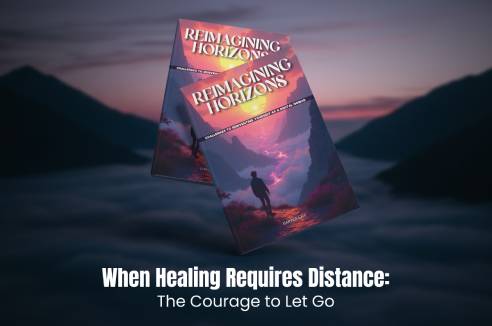
Grief changes relationships in ways that are often invisible at first. In the aftermath of profound loss, connections that once felt steady can become strained, distorted, or unsustainable. It is not because of malice or failure, but because grief alters needs, boundaries, and perceptions. This truth sits at the heart of When Healing Requires Distance: The Courage to Let Go, an exploration of how love, support, and dependency can blur after loss, and why separation can sometimes be the most honest form of care.
In the memoir underlying this reflection, a relationship evolves from caregiving into companionship and then into emotional reliance. What begins as kindness slowly becomes pressure. The grieving individual, without realizing it, looks to another person to fill the silence left by a spouse of decades, not romantically at first, but existentially. Therapy later reveals the cost of this dynamic: dependency that distorts perception and makes it difficult to recognize the other person’s autonomy, limits, and needs.
Why Some Relationships Cannot Survive Grief Unchanged
Grief dismantles the architecture of daily life. After the death of a long-term partner, familiar roles vanish overnight: spouse, companion, and witness to a shared history. In that vacuum, the grieving person is not simply sad; they are disoriented, searching for stability in a world that no longer feels coherent. Relationships formed or intensified during this period are inevitably shaped by that instability.
Some bonds deepen and endure. Others, however, are forged under conditions that cannot last. When a relationship begins as a response to a crisis, especially one rooted in caregiving or emotional rescue, it may carry expectations that are impossible to fulfill once the acute phase of grief passes. The relationship does not fail because the people involved are flawed; it changes because grief itself is not static. As healing progresses, what once felt necessary may begin to feel constricting, misaligned, or quietly unsustainable.
The Difference between Support and Substitution
Support helps a grieving person stand again. Substitution, by contrast, asks another person to take the place of what was lost. The distinction can be subtle, especially when loneliness is overwhelming, and companionship feels like oxygen. Yet the consequences are profound.
Healthy support respects separateness. It acknowledges that the grieving person must eventually rebuild an internal sense of home rather than anchor their survival to someone else’s presence. Substitution, even when unintentional, collapses that distance. One person becomes the emotional center that another has lost, inheriting expectations they never agreed to carry.
Conflict as an Unavoidable Truth-Teller
Conflict is often treated as something to be avoided, especially in fragile emotional states. But encounter has a way of surfacing truths that silence cannot hold. In grief-shaped relationships, tension frequently emerges around unspoken assumptions: expectations about time, plans, emotional availability, or the meaning of shared experiences.
A single question asked hesitantly, without intent to harm, can rupture an entire dynamic. When boundaries that were never clearly named are crossed, even gently, the relationship shifts. Defensiveness replaces ease. Misunderstandings multiply. What once felt supportive begins to feel fraught.
Yet conflict is not the enemy here. It is the moment when reality asserts itself. It exposes mismatched needs and reveals where a relationship can no longer stretch without breaking. In this sense, conflict becomes a truth-teller, insisting that something fundamental must change even if neither party yet knows how.
Choosing Separation without Assigning Blame
Letting go is often framed as failure or rejection. In reality, it can be an act of discernment. Not all endings require villains. Some relationships simply cannot continue without causing harm, confusion, or emotional erosion.
Choosing separation without assigning blame requires humility. It asks both people to acknowledge that good intentions do not guarantee health outcomes. It means recognizing that grief can warp expectations, create imbalances of emotional power, and pull people into roles they never chose.
In the memoir’s turning point, separation arrives quietly, without dramatic confrontation. Plans are canceled. Futures once imagined together dissolve. What remains is a mutual recognition that the relationship, as it exists, cannot continue. This restraint and refusal to turn pain into accusation is itself a form of respect. It allows both individuals to step away with dignity rather than resentment.
Letting Go as an Act of Integrity
Letting go is not the abandonment of love; it is the refusal to misuse it. When a relationship no longer honors the individuality of both people, continuing it becomes an ethical problem, not an emotional one.
Integrity means choosing honesty over comfort. It means accepting solitude rather than clinging to a connection that substitutes presence for healing. In the memoir, this choice opens the door to reinvention. By releasing a relationship that had become entangled with unresolved grief, the author creates space to redefine home, identity, and belonging from within.
Healing, ultimately, requires distance, not to erase connection, but to restore proportion. Grief does not disappear, but it becomes livable. Love does not end, but it changes form. Life, once again, becomes something chosen rather than endured.
When Healing Requires Distance reminds us that courage is not only found in holding on. Sometimes it lives in the quieter, harder decision to let go, so that both people may continue forward completely.