


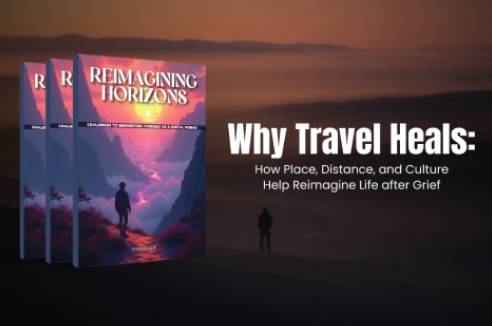
Introduction: Why Travel Becomes a Refuge after Loss
After a profound loss, familiar spaces can become unbearable. Rooms echo with absence, routines replay memories, and even the simplest tasks are shadowed by what once was. In this emotional terrain, travel often emerges not as an indulgence but as a refuge. It offers temporary relief from the relentless reminders embedded in everyday life. More importantly, it introduces motion at a time when grief makes everything feel frozen.
Travel does not erase sorrow, nor is it a cure for grief. Instead, it creates breathing room. Distance softens the intensity of pain just enough to allow curiosity to return. In unfamiliar places, grief loosens its grip, making space for reflection, perspective, and the possibility, however tentative, of imagining life beyond loss.
However, people can still move out and roam around places to try to forget their grief. Obviously, it will not be done overnight, but it will take some time for them to get back to their normal life. Old partners find it extremely difficult to cope with the loss of their spouse, with whom they have lived their entire life together.
Georgia as a Symbolic Landscape of Renewal
In the memoir’s journey, Georgia becomes more than a destination; it becomes a symbolic landscape of renewal. Its ancient history, resilient culture, and unhurried pace offer a stark contrast to the clinical, grief-saturated environment left behind. Georgia’s mountains, vineyards, and centuries-old traditions embody the endurance of an unbroken continuity shaped by survival rather than sentimentality.
For someone navigating grief, such a place offers quiet instruction. Georgia demonstrates how identity can persist despite repeated upheaval. The country’s ability to hold past and present simultaneously mirrors the grieving individual’s challenge: honoring what was while remaining open to what might be.
The warmth of Georgian hospitality, the intimacy of shared meals, and the rhythm of daily life grounded in tradition provide a sense of belonging without obligation. Here, grief is not center stage; it simply coexists with beauty, culture, and human connection.
Being Unknown: The Relief of Shedding the “Widower” Identity
One of the most unexpected gifts of travel after loss is anonymity. In familiar settings, grief becomes a label. Friends and acquaintances see the mourner through the lens of tragedy, often with well-meaning but limiting expectations. Every interaction carries the weight of explanation or sympathy.
In a foreign place, that identity dissolves. The grieving person becomes simply a traveler, someone ordering coffee, navigating streets, asking questions. This anonymity offers profound relief. Without the constant reinforcement of loss, the self has room to re-emerge.
Being unknown allows grief to step out of the spotlight. It becomes something carried privately rather than performed socially. This shift does not diminish love or memory; it restores balance, allowing identity to expand beyond bereavement.
Memory and Presence: Carrying Love into New Experiences
Travel does not sever memory. In fact, it often sharpens it in unexpected ways. New landscapes evoke reflection: They would have loved this view. This would have made them smile. Rather than intensifying pain, these moments can soften it, integrating memory into presence.
In grief, there is often fear that moving forward means leaving the loved one behind. Travel challenges this belief. It reveals that memory is not tied to location. Love travels easily. It accompanies new experiences without dominating them.
By carrying memory into unfamiliar places, the grieving individual learns that presence and remembrance are not mutually exclusive. Life continues not despite loss, but alongside it.
Travel as Curiosity Rather Than Escape
There is a fine line between travel as escape and travel as engagement. When used to avoid grief, travel becomes restless and hollow. However, when approached with curiosity, it becomes transformative.
Curiosity invites attention to language, culture, food, and history. It draws the grieving person outward, gently interrupting the inward spiral of loss. This engagement restores a sense of agency. Decisions are made not out of survival, but interest.
Travel grounded in curiosity encourages listening rather than fleeing. It replaces avoidance with openness, allowing grief to breathe rather than be suppressed. In this way, travel becomes an active form of healing, not a distraction from pain.
Conclusion: Movement as a Catalyst for Emotional Renewal
Grief is often described as a process, but it is equally a state of stasis. Loss immobilizes. Travel introduces movement, not just across geography, but also within the self. It shifts perspective, reintroduces wonder, and reminds the grieving individual that life contains more than what has been lost.
Movement does not resolve grief. It reshapes it. Through place, distance, and culture, travel offers a way to reimagine life without demanding closure or forgetting. It affirms that renewal does not require replacement, only the courage to keep moving.
In the end, travel heals not because it takes grief away, but because it teaches how to carry it lightly enough to continue, honestly enough to grow, and openly enough to imagine again.