Blog
Bridging Horizons: The Art of Cross-Cultural Collaboration

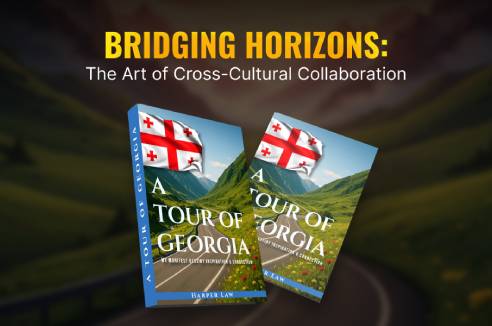
When John first landed in Tbilisi, he arrived as many travelers do: with a suitcase full of expectations and a heart heavy with personal loss. Following the passing of his wife, Celia, the American writer was searching for a change of scenery, a quiet corner of the world to retreat into his thoughts. What he found instead was a vibrant, ancient culture that refused to let him remain a spectator.
The story of how a simple travel experience evolved into “Bridging Horizons,” a dedicated cultural exchange initiative between Georgia and the United States, is a testament to the transformative power of cross-cultural partnership. It is a journey that suggests travel is not just about the places we go, but the bridges we build while we are there.
From Outsider to Participant: The Transformation of a Traveler
In the early chapters of Harper Law’s A Tour of Georgia, John is a classic outsider. He observes the “tree-lined streets” of the Vake district and the “melancholy beauty” of the Caucasus mountains through the lens of a visitor. However, Georgia has a way of pulling people in. Through the hospitality of the local people and the infectious passion of his collaborator, Anna, John’s perspective began to shift.
He realized that Georgia was not just a backdrop for his grief; it was a living classroom. He moved from merely documenting the sights to becoming an active advocate for the country’s heritage. This transformation from a “curious traveler” to a cultural participant is the heartbeat of the manuscript. John stopped asking “What can I see here?” and started asking “How can I share this with the world?” This shift in mindset is the essential first step in any true collaboration: moving from observation to contribution.
The Collaborative Process: Writing Between Worlds
The foundation of the “Bridging Horizons” initiative was the creative partnership between John and Anna. Despite a forty-year age gap and vastly different cultural backgrounds, they found a common language in storytelling.
The collaborative process was not without its challenges. Behind the scenes, it involved navigating different nuances of language, varying historical perspectives, and the logistical hurdles of organizing international symposiums. They spent countless hours in Tbilisi apartments and mountain guesthouses, debating how to translate the “Georgian soul” for an American audience.
Their work went beyond the pages of a book. They began organizing cultural symposiums that brought together Georgian scholars and American thinkers. This was not a top-down academic exercise; it was a grassroots effort. By combining John’s seasoned writing style with Anna’s deep local knowledge and contemporary Georgian perspective, they created a narrative that was both accessible to Westerners and authentic to Georgians. Their partnership proved that the best way to understand a culture is not to study it from afar, but to build something meaningful alongside its people.
Mutual Enrichment: Connecting Students and Creators
As “Bridging Horizons” grew, its impact expanded to a new generation. One of the initiative’s most significant achievements was facilitating connections between American students and Georgian artists and historians.
For the American students, the program offered a radical departure from traditional history books. They were not just learning about the 8,000-year history of Georgian wine or the medieval towers of Svaneti; they were talking directly to the winemakers and the families who had lived in those towers for generations. They witnessed a culture that balances fierce modernization with a deep, unwavering respect for the past.
Conversely, the impact on Georgian participants was equally profound. For local artists and historians, the exchange provided a global platform. They saw their traditions often overlooked by the West, celebrated and analyzed with fresh eyes. This mutual enrichment created a “virtuous cycle”: Americans gained a deeper understanding of human resilience and ancient heritage, while Georgians gained international recognition and a renewed sense of pride in their unique cultural contributions.
Conclusion: The Enduring Power of Stories
The manuscript concludes with John and Anna preparing to travel to Europe to present their work, a final signal of John’s complete integration into Georgia’s ongoing narrative. Their journey reminds us that in an increasingly fragmented world, the art of cross-cultural collaboration is more vital than ever.
“Bridging Horizons” is more than just a title; it is a philosophy. It teaches us that stories are the most effective tools we have to bridge divides, dismantle stereotypes, and inspire mutual respect. When we approach a foreign culture with the humility of a student and the dedication of a partner, we do not just “tour” a country, we become a part of its story.
John’s journey from the streets of New York to the heart of the Caucasus proves that it is never too late to find a second home or a new purpose. Through collaboration, we expand our own horizons, discovering that the things that make us different are often the very things that make our collective story so rich and enduring.