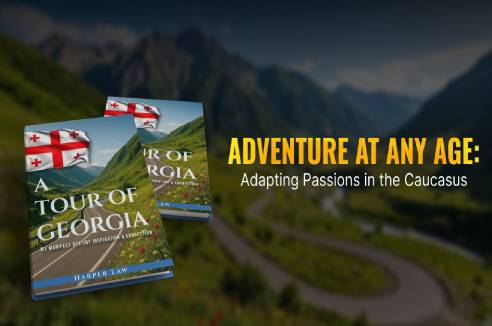
Standing at the base of the Kudebi Mountain in Gudauri, the crisp alpine air of the Greater Caucasus fills the lungs with a sharp, exhilarating chill. For decades, John Matthews, the seasoned American writer at the heart of Harper Law’s A Tour of Georgia, viewed such peaks as challenges to be conquered.
In his younger years, the thrill of travel was found in the speed of the descent, the “aggressive skiing” that pushed physical limits and invited a rush of adrenaline. But as he stood amidst the shimmering snowfields of Georgia’s premier ski resort, a new realization began to take hold: age is not a barrier to adventure, but a lens through which adventure is redefined.
Redefining Adventure: From Slopes to Snowshoes
In our youth, we often define adventure by intensity. We seek the steepest slopes, the fastest routes, and the most physically demanding feats. However, as John navigates his “second act” in Georgia, he encounters a pivot point in Gudauri. While the younger crowds around him prepare for high-speed runs down the mountain, John discovers the quiet, rhythmic allure of snowshoeing.
This transition from “aggressive skiing” to a more measured pace is not a retreat; it is an evolution. Snowshoeing allows for a different kind of engagement with the landscape. Where skiing is about the blur of motion, snowshoeing is about the clarity of the moment. It requires a different kind of endurance, one that rewards the traveler with the crunch of virgin snow underfoot and the ability to traverse areas unreachable by those tied to the lift lines.
By trading the skis for snowshoes, John demonstrates that the spirit of exploration does not diminish with age; it simply changes its tools. Adventure is no longer about the conquest of the mountain, but about the intimacy of the journey across it.
The Wisdom of Slowing Down: Meaningful Connections
One of the most profound lessons John learns in the Caucasus is that speed often acts as a filter, blurring the very details that make a place special. By intentionally slowing down, he opens himself up to “meaningful connections” that he might have zoomed past in his younger years.
Slowing down in a place like Gudauri means having the time to stop at a mountainside hut for a steaming cup of herbal tea and a conversation with a local shepherd who has seen decades of winters. It means noticing the specific way the light hits the jagged peaks of the Jvari Pass or observing the resilience of the mountain flora peeking through the frost.
This “wisdom of slowing down” allows for a deeper absorption of the environment. In the manuscript, John’s interactions with his collaborator Anna are enriched by this pace. Their discussions about Georgian history, philosophy, and the “power of stories” are not rushed between activities; they are the activity. When we stop trying to “see it all,” we finally begin to “see what matters.”
Embracing Change: Joy Through Adaptation
There is a common misconception that aging is a process of loss. However, it may be a loss of speed, a loss of strength, or a loss of capability. But John’s time in the mountains reframes this as a process of adaptation. He finds a deep, resonant “joy in the mountains” not by pretending he is twenty years younger, but by embracing exactly where he is.
Adaptation is an art form. It is the ability to look at a mountain and say, “I may not conquer your steepest cliff today, but I will understand your silence better than I ever did before.” This shift from conquest to appreciation is where true fulfillment lies. In Gudauri, John realizes that his identity as an adventurer is not tied to a specific physical feat, but to his unwavering curiosity and his willingness to engage with the world on new terms. He learns to celebrate the “weight of history” and the “breadth of the horizon” rather than the vertical drop of a ski run.
Conclusion: Embracing New Chapters with Grace
The snowy heights of the Caucasus serve as a grand metaphor for the later chapters of life. As the sun sets over Gudauri, casting long, violet shadows across the valleys, John stands as a testament to the beauty of aging with an open heart.
The lesson he brings back from the mountains is one we can all apply, regardless of our age: every stage of life offers a different kind of beauty, provided we are willing to adapt our passions to meet it. Embracing new chapters is not about holding onto the past with a white-knuckled grip; it is about reaching out to the future with a sense of wonder.
John’s journey reminds us that fulfillment is not found in a destination or a physical record, but in the grace with which we navigate change. Whether we are walking through the streets of Tbilisi or snowshoeing through the alpine meadows of Gudauri, the true adventure is the internal growth that happens when we step outside our comfort zones. Age, after all, is just one aspect of identity; the soul remains an eternal traveler, forever seeking the next horizon.