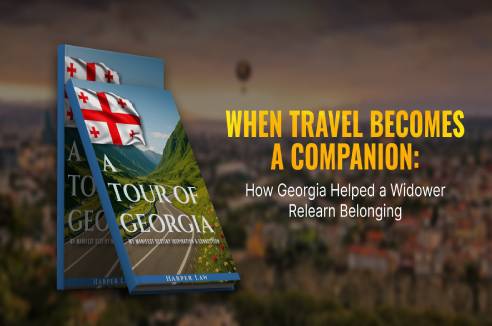
Travel is often framed as a form of escape. It is a chance to step away from routines, responsibilities, or even the weight of personal grief. But for some, travel does more than offer a temporary distraction. It becomes a companion, a steady presence that allows one to feel seen, understood, and, slowly, at home again. This was the case for John Matthews, an American widower, whose repeated journeys to Georgia. The country at the crossroads of Europe and Asia transformed his experience of loss into a deeper understanding of belonging.
For John, grief was never a destination to reach or a state to “get over.” It was a companion on every train ride, market visit, and evening stroll. After the death of his wife, Celia, the bustling streets of New York felt both familiar and alien. The city’s energy, which once inspired and comforted him, now underscored a quiet disconnection. Grief, in its rawness, demanded space. Travel, he realized, could provide that space, but only if approached not as escape, but as a dialogue with the world.
Georgia became more than a geographic location; it became an emotional anchor. John’s first visit was tentative, a response to a suggestion from friends who had spoken warmly of Tbilisi’s charm, the warmth of its people, and the vibrant interplay of history and daily life. But what drew him back again and again was something subtler: a sense of continuity that did not erase loss but allowed him to carry it lightly. The mountains, the cobbled streets, the scent of bread baking in small bakeries, they became touchstones for memory and reflection, each sensory encounter a quiet conversation with the past and present.
Returning with intention transformed John’s travel from sightseeing to participation. He began to approach Georgia not as a visitor checking off landmarks but as someone willing to be present in ordinary moments. Early mornings in Tbilisi’s open-air markets became opportunities to observe, connect, and engage. He learned the names of local fruits, exchanged greetings with stallholders, and let the rhythm of everyday commerce unfold around him.
Walking along the banks of the Kura River, he watched children play and couples linger on benches, letting the city teach him patience and attentiveness. Even simple acts, like sharing a meal in a small café or practicing Georgian phrases with neighbors, became exercises in reclaiming connection and agency.
Writing, too, became a companion alongside place. John kept a journal throughout his visits, but rather than chronicling the sights, he recorded the subtleties of his feelings: the quiet relief of being in a place that didn’t demand performance, the gentle tug of memory when a song drifted from a café, the surprise of discovering laughter in unexpected corners. In these written reflections, Georgia became not a backdrop but an active participant in his healing. The act of observing and documenting allowed grief to be acknowledged without being consumed by it.
What emerged through these repeated visits was a redefinition of belonging. John realized that belonging does not have to be tethered to permanence. It is not always about owning a home or constructing a life in a singular location; it is about cultivating relationships with people, with routines, with landscapes that provide a sense of continuity and resonance. Georgia, with its layered history, hospitality, and vibrant street life, offered precisely this. By choosing to return, John was signaling to himself that belonging is an ongoing negotiation, one that can be shaped by intention and presence rather than circumstance alone.
Travel, in this sense, is neither a cure nor a distraction. It is a form of companionship, a steady presence that can guide, support, and mirror inner states. For a widower navigating the delicate terrain between remembrance and renewal, Georgia offered this companionship in abundance. Its streets, cafés, markets, and mountains became part of a personal ecosystem, one that acknowledged grief without being defined by it, one that welcomed joy without guilt, one that reminded him that life, though altered, remained rich with possibility.
The lessons John’s journey offer are universal: sometimes, the places we visit teach us more than the people we meet. They show us that home is not solely a fixed location, but a constellation of moments, interactions, and attentions. Belonging, then, is not only about permanence but about engagement, care, and presence. By allowing Georgia to be a companion, John discovered that travel could be a living dialogue with life itself, an ongoing conversation between memory, grief, and renewal.
In the end, Georgia did not erase the loss, nor did it demand that it be set aside. Instead, it offered a framework within which grief could coexist with life’s continuing flow. Each return visit became a reaffirmation that belonging is not about finishing a journey or resolving pain. It is about participating in a world that embraces you, one that allows you to feel connected, to feel present, and to feel, slowly, that life, in all its complexity, can still be deeply lived.